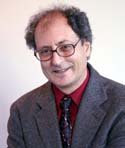
My scientific mentor, Richard (Dick) Norberg, died this spring. He provided my training as a scientist and supervised my doctoral thesis. Dick was a professor of physics at Washington University in Saint Louis for more than 50 years, and a pioneer in the field of magnetic resonance. Long before magnetic resonance (MR) became part of the medical imaging technique known as MRI, he made key discoveries and obtained insights that led to our modern understanding of the phenomena.
I worked with Dick for three years in his laboratory at Washington University. Learning to become a scientist is nothing like school would lead you to believe. Science, as it is practiced by scientists, is more of a craft than a method. Graduate training in science is akin to an apprenticeship in which an aspiring scientist learns the trade from a master craftsman. Each master has his or her own style and approach. I am often confused when my children ask me for help with their science homework because I am unfamiliar with the "scientific method" their classes teach. For an excellent article on how actual scientists conduct science see: "How Science Works." It is on a Website http://www.UnderstandingScience.org that provides resources for K-12 teachers to correct many misconceptions about the process of doing science.
Dick loved doing physics and remained enthusiastic and engaged until the very end of his life. I loved having him as a teacher. He expressed his usually strong opinions in ways that stayed with you forever. I can still hear his voice when I recall the many words of wisdom he imparted. Some examples of his observations and advice:
"Any academic department with the word 'science' in its name is not."
I recalled that statement with a chuckle the year after I left Washington University to do postdoctoral research at the University of Georgia. On one of my daily walks from the bus stop past the school of home economics I noticed that a new sign had gone up in front of the building that said: "School of Consumer Sciences."
"When you write a paper, always separate the data and put it first. What you say about the data might turn out to be wrong later on. But, if you did the experiment correctly the data will be true forever."
This is actually a profound insight on the nature of scientific progress that many people fail to understand, and high school science classes fail to teach. People are always quick to point out that scientific theories change and that many ideas scientists of the past believed turned out to be wrong. The implication is that nothing about science is permanent. But, nature does not change. An experiment poses a question directly to nature and the answer that comes back will always be true. All future scientific theories will still have to explain today's scientific facts.
But, the most important advice I received from Dick Norberg was on the day I left. I had completed and defended my doctoral thesis, finished up with the movers, and packed my car for the drive to my new city and job. I stopped at his office to thank him and say goodbye. His parting words were:
"Whatever you do in life, do what you enjoy. Don't do what others expect. Your wife, your parents, your children, your friends, will all have expectations. Don't give into them. Do what you most enjoy."
As time has gone on, my appreciation of this advice has grown. As a teacher for the past 16 years, I've seen many students sabotaged by expectations.
I've seen students in majors for which they have no real interest or aptitude, but their parents refuse to fund their college education unless they study something "practical." The result is students in engineering programs even though they cannot do the math and have no interest in building anything. There are also students muddling through business degrees who would be much better served in the long run with a liberal arts degree. It is actually more practical to have good grades in history major than bad grades in a business major.
I've seen students who are not mature enough to be in college but go because it is the expected next step after high school. The result is that they are wasting their time and their parent's money. Partying all night and sleeping all day can be done at a much lower cost at home than in college, and the results achieved will be the same.
I've seen exceptionally smart students who should become scientists, but their parents expect them to become medical doctors because of the prestige it will bring to the family. The result is if you ask these students why they are so passionate about medicine that they intend to devote their life to its practice, they can only express a nebulous desire to "help people." Of course, I can think of many professions that "help people" and are unrelated to medicine. If you intend to become a medical doctor you should have a real interest in medicine.
I've seen students juggle the demands of double and even triple majors so that they can pursue their interests and satisfy family expectations. The result is a great deal of stress from pursuing credentials that have little meaning in the long run. Employers care more that you have a degree with decent grades than all the majors and minors that you acquired along the way.
My own three children are all artists. I have two in college and one in high school. They are now aware enough to observe friends doing what's expected. My daughter said to me one day: "I'm so happy that you and mom support me. You don't discourage my interest in theater and force me do something else. Many of my friend's parents aren't like that."
I said: "You have to do what you enjoy the most and see where your interests and talents take you. You'll figure out how to earn a living. You can't spend your life doing what others expect."
I thought about Dick Norberg when I said that. Dick loved to teach and loved doing physics. I was one of 47 doctoral students he taught in his more than half-century as a physics professor. Had he wanted, he could have held more prestigious administrative positions at the university. But those kinds of positions would have kept him away from research and teaching.
I now realize that as a teacher he wasn't just speaking to me that day. He was speaking to my children and my students, and in the future their children and students. Teachers have the ability to speak to the future. That is what he enjoyed.
Joseph Ganem is a physicist and author of the award-winning The Two Headed Quarter: How to See Through Deceptive Numbers and Save Money on Everything You Buy
Sunday, August 1, 2010

Sunday, July 4, 2010
The BP Oil Spill: Why Slow Is Much Faster
As I read an article in the online Wall Street Journal about the equipment failures leading to the disastrous oil spill in the Gulf of Mexico, I am reminded of a lesson that I teach my laboratory students. It is this: The fastest, cheapest way to get something done is to proceed slowly. Check and recheck each step before proceeding to the next. Don't rush and don't make assumptions. It is counterintuitive advice to give students, who like everyone else, are in a hurry. But, as BP is finding out, assumptions can be costly, time consuming, and deadly.
The Wall Street Journal investigation is the most complete account to date in the media of what went wrong on the Deepwater Horizon. It is a story of rushed procedures and faulty assumptions that appear motivated by schedule and budget considerations. For example:
The article also reported that on the day (April 20) the Deepwater Horizon exploded and sank, a disagreement broke on the rig over the procedures to be followed. A BP official had a "skirmish" with Transocean officials over how to remove drilling mud. BP prevailed and several hours later 11 people were dead and oil was spewing into the Gulf.
It appears that all involved knew corners were being cut, but a consensus emerged that the process would "most likely work." The cementing contractor Halliburton said that it followed BP's instructions, and that while some "were not consistent with industry best practices," they were "within acceptable industry standards."
But, the problem with complex equipment and procedures is that "most likely" can easily become "very unlikely" when everything has to function. Simply adhering to "acceptable standards" is no guarantee that everything will work.
This is lesson my students usually have to learn the hard way, even though it can be proved mathematically. Suppose you have a 90% confidence in your ability to make electrical connections. You think that if you wire your project without conducting tests, it will have a 90% chance of working. But, if you have 10 connections and each one must work, it is unlikely your project will succeed. The reason is that probabilities for simultaneous events multiply. If two events with a 90% chance of success must occur together, the likelihood of the combined events happening is (0.9) x (0.9), or 0.81, which is 81%. If 10 simultaneous events must occur, the chance becomes (0.9) multiplied by itself 10 times (0.9)10, or 0.35, which is a 35% chance of success.
A relative high confidence of 90% for a single can connection can be a deceiving number if all of them have to work. Worse still, when it doesn't work, you won't know why. It is difficult and time consuming to track down errors. The only solution is to spend extra time during assembly to test each connection when you make it, before proceeding to the next one.
I see this problem all the time when I teach. Students will follow the assembly instructions but do not perform the tests as they go along. They assume everything is correctly assembled. At the end they will have a beautiful piece of equipment that doesn't work. It is brought to me to figure out why and the students watch in dismay as I dismantle it piece by piece to search for the problem. Sometimes it is a mistake or misunderstanding on the first step, and that forces the students to begin all over again. They learn that time-consuming testing actually saves time.
It's not only students that struggle with this lesson. A friend once asked me for help wiring an external keyboard he purchased for a handheld device. He had followed the instructions, but after making all the connections it didn't work. Frustrated and confused he didn't know what to do next. He took it apart, put it back in the box, and called me.
He came to my office where I spread the parts out on my desk and followed the enclosed wiring instructions. But, after making each connection, I tested it with an electrical meter while twisting and pulling to make sure it was secure. I did this for every connection, because I made no assumptions about reliability based on how it looked or the high probability that almost all the connections I make are secure. When I finished, I turned the device on and it worked.
My friend said: "But, I wired it the same way you did. Why didn't it work?"
"You didn't do the same thing I did. You didn't test each connection when you made it. When it didn't work, you had no good way of finding a single bad connection, which is all that is needed for it to fail. I made sure each connection worked before I continued to the next one."
For highly complex equipment, such as on oil drilling platform, a 99.9% success rate for each step might not be acceptable. Consider a procedure that involves 10 steps with a 99.9 % chance of succeeding. The number 0.99910 is equal to .99, or 99%. A 1% chance of failure sounds safe, but the fact is 1% events happen frequently, about 1% of the time to be exact. If an event with a 1% frequency results in deaths, injuries, environmental and economic devastation, and possible bankrupting of the company, the risk is unacceptably large.
But, what is most disturbing is that even if the executives at BP making decisions understood the mathematics of risk it might not have made any difference. The root of cause the Gulf oil spill is the same as the root cause of the financial meltdown two years earlier. The executives take dangerous risks because they realize enormous personal gain when they succeed, while others will pay for the losses when they fail.
Imagine if Tony Hayward, BP's CEO, faced personal financial ruin from an oil spill. What if he had to contemplate having no yacht, no house, no assets, no job, and complete loss of livelihood? After all, those are the circumstances facing thousands of people on the Gulf coast as a result of the oil spill. What if Tony Hayward had to personally operate the equipment on the Deepwater Horizon so that its failure would end his life as it did eleven others? Do you think he would run his company differently? I bet if his life and livelihood were on the line he would make sure careful testing is done to insure safety for all concerned.
Unfortunately, the most likely outcome of this disaster is that nothing will change. There will be calls for tougher regulation, but, just like the financial overhaul working its way through Congress, change will be cosmetic. Opponents of more financial regulation use the same rhetoric as opponents of more oil industry regulation. They denounce increased regulation as an attack on "free markets."
But for "free markets" to work the agents must have a personal stake in the outcomes. Real free markets are composed of the thousand of small business owners and their workers who have a personal financial stake in their successes and failures. It's a sham to say that the executives of banks and oil companies are agents in a free market when they can only reap profits, while everyone else pays for their losses.
Joseph Ganem is a physicist and author of the award-winning The Two Headed Quarter: How to See Through Deceptive Numbers and Save Money on Everything You Buy
The Wall Street Journal investigation is the most complete account to date in the media of what went wrong on the Deepwater Horizon. It is a story of rushed procedures and faulty assumptions that appear motivated by schedule and budget considerations. For example:
- BP cut short a procedure designed to detect gas in the well and remove it before it becomes a problem.
- BP skipped a quality test of the cement around the pipe (despite a warning from the cement contractor).
- BP installed fewer centering devices than recommended (6 instead of 21).
The article also reported that on the day (April 20) the Deepwater Horizon exploded and sank, a disagreement broke on the rig over the procedures to be followed. A BP official had a "skirmish" with Transocean officials over how to remove drilling mud. BP prevailed and several hours later 11 people were dead and oil was spewing into the Gulf.
It appears that all involved knew corners were being cut, but a consensus emerged that the process would "most likely work." The cementing contractor Halliburton said that it followed BP's instructions, and that while some "were not consistent with industry best practices," they were "within acceptable industry standards."
But, the problem with complex equipment and procedures is that "most likely" can easily become "very unlikely" when everything has to function. Simply adhering to "acceptable standards" is no guarantee that everything will work.
This is lesson my students usually have to learn the hard way, even though it can be proved mathematically. Suppose you have a 90% confidence in your ability to make electrical connections. You think that if you wire your project without conducting tests, it will have a 90% chance of working. But, if you have 10 connections and each one must work, it is unlikely your project will succeed. The reason is that probabilities for simultaneous events multiply. If two events with a 90% chance of success must occur together, the likelihood of the combined events happening is (0.9) x (0.9), or 0.81, which is 81%. If 10 simultaneous events must occur, the chance becomes (0.9) multiplied by itself 10 times (0.9)10, or 0.35, which is a 35% chance of success.
A relative high confidence of 90% for a single can connection can be a deceiving number if all of them have to work. Worse still, when it doesn't work, you won't know why. It is difficult and time consuming to track down errors. The only solution is to spend extra time during assembly to test each connection when you make it, before proceeding to the next one.
I see this problem all the time when I teach. Students will follow the assembly instructions but do not perform the tests as they go along. They assume everything is correctly assembled. At the end they will have a beautiful piece of equipment that doesn't work. It is brought to me to figure out why and the students watch in dismay as I dismantle it piece by piece to search for the problem. Sometimes it is a mistake or misunderstanding on the first step, and that forces the students to begin all over again. They learn that time-consuming testing actually saves time.
It's not only students that struggle with this lesson. A friend once asked me for help wiring an external keyboard he purchased for a handheld device. He had followed the instructions, but after making all the connections it didn't work. Frustrated and confused he didn't know what to do next. He took it apart, put it back in the box, and called me.
He came to my office where I spread the parts out on my desk and followed the enclosed wiring instructions. But, after making each connection, I tested it with an electrical meter while twisting and pulling to make sure it was secure. I did this for every connection, because I made no assumptions about reliability based on how it looked or the high probability that almost all the connections I make are secure. When I finished, I turned the device on and it worked.
My friend said: "But, I wired it the same way you did. Why didn't it work?"
"You didn't do the same thing I did. You didn't test each connection when you made it. When it didn't work, you had no good way of finding a single bad connection, which is all that is needed for it to fail. I made sure each connection worked before I continued to the next one."
For highly complex equipment, such as on oil drilling platform, a 99.9% success rate for each step might not be acceptable. Consider a procedure that involves 10 steps with a 99.9 % chance of succeeding. The number 0.99910 is equal to .99, or 99%. A 1% chance of failure sounds safe, but the fact is 1% events happen frequently, about 1% of the time to be exact. If an event with a 1% frequency results in deaths, injuries, environmental and economic devastation, and possible bankrupting of the company, the risk is unacceptably large.
But, what is most disturbing is that even if the executives at BP making decisions understood the mathematics of risk it might not have made any difference. The root of cause the Gulf oil spill is the same as the root cause of the financial meltdown two years earlier. The executives take dangerous risks because they realize enormous personal gain when they succeed, while others will pay for the losses when they fail.
Imagine if Tony Hayward, BP's CEO, faced personal financial ruin from an oil spill. What if he had to contemplate having no yacht, no house, no assets, no job, and complete loss of livelihood? After all, those are the circumstances facing thousands of people on the Gulf coast as a result of the oil spill. What if Tony Hayward had to personally operate the equipment on the Deepwater Horizon so that its failure would end his life as it did eleven others? Do you think he would run his company differently? I bet if his life and livelihood were on the line he would make sure careful testing is done to insure safety for all concerned.
Unfortunately, the most likely outcome of this disaster is that nothing will change. There will be calls for tougher regulation, but, just like the financial overhaul working its way through Congress, change will be cosmetic. Opponents of more financial regulation use the same rhetoric as opponents of more oil industry regulation. They denounce increased regulation as an attack on "free markets."
But for "free markets" to work the agents must have a personal stake in the outcomes. Real free markets are composed of the thousand of small business owners and their workers who have a personal financial stake in their successes and failures. It's a sham to say that the executives of banks and oil companies are agents in a free market when they can only reap profits, while everyone else pays for their losses.
Joseph Ganem is a physicist and author of the award-winning The Two Headed Quarter: How to See Through Deceptive Numbers and Save Money on Everything You Buy
Saturday, February 27, 2010
Financial Literacy: Maryland's Education Proposal
The Baltimore Sun recently published an op-ed piece by Maryland Comptroller Peter Franchot, supporting proposed legislation in the Maryland General Assembly to require all high school students to complete a stand-alone course on financial literacy before graduation. Franchot argues that educating our children in the basics of financial literacy will help avert future economic downturns. As is typical of many people in the government, he blames the recent economic crisis on bad choices made by consumers. Mr. Franchot writes:
"Thus, in far too many instances, we entered into financial commitments that we couldn't afford, with terms and conditions that we didn't truly understand, in order to buy things that we really didn't need. If more Marylanders had the benefit of sound financial literacy education, fewer of our friends and family members would be facing the loss of homes and life savings today."
I think teaching financial literacy to high school students is a good idea. But, the problems with the financial system go far deeper than a new high school course will fix.
First there is the problem with "stand alone" courses. To understand personal finance, students need to understand more about math, especially arithmetic, than they currently do. Many consumers made bad decisions on loans because they did not understand the basic math behind interest and payment calculations. My own belief is that personal finance education should be woven into current math courses. It would make math more interesting, and therefore relevant. Too many students, and adults view math as a "stand-alone" subject with no connection to their daily lives. If consumers learned just how many dollars their lack of mathematical knowledge costs them in the marketplace, they would see that math is an important subject.
Second there is widespread corporate-government collusion to deceive consumers and then blame them for falling victim to the deception.
I gave a talk on the U. S. mortgage crisis at an international conference on science in society at Cambridge University in the United Kingdom this past summer. In academic jargon the paper I presented was titled: "Quantitative Reasoning Applied to Modern Advertising." The term "quantitative reasoning" just means applying arithmetic to real-world problems. It is a way of thinking that is second nature to scientists, but unknown to most people outside of science.
I argued that if consumers learned some of these quantitative reasoning methods, they could greatly improve their day-to-day financial decision-making. I concluded that the best way to effect economic change is through the market. I said that people selling mortgages act according to their financial interests. In response, consumers need to educate themselves to make choices that are in their best financial interests.
After my presentation, an Australian economist, in a private conversation, disagreed with my conclusion. He said that home pricing, and mortgages are too complex for the average person to understand. It is incumbent on the government to regulate the market. He said that Australian government did not allow the kind of toxic mortgage products that brought down financial institutions in the US and UK, and wiped out millions of homebuyers. As a result, Australia did not have a mortgage crisis.
I admitted that my American bias influenced my conclusion. I told him that in the United States, government and corporate corruption is so institutionalized, that meaningful regulations to safeguard the financial well being of average Americans would never be implemented. From my viewpoint, education is the only realistic way American consumers have to protect themselves.
But, my viewpoint is not meant to excuse corrupt behavior. If you leave your house unlocked and are robbed, you made a bad choice. But, a crime was still committed. If you agreed to a mortgage that you didn't understand, you made a bad choice. But, the lender should have made sure that you understood the mortgage. Instead, lenders created mortgages designed not to be understood.
That is why I get so angry when I see government officials like Mr. Franchot blaming uneducated consumers for the financial crisis. Education is needed, but it will only go so far in fixing our financial problems. It will not replace trust. All parties to a contract must act in good faith for our financial system to work.
Joseph Ganem is a physicist and author of the award-winning The Two Headed Quarter: How to See Through Deceptive Numbers and Save Money on Everything You Buy
"Thus, in far too many instances, we entered into financial commitments that we couldn't afford, with terms and conditions that we didn't truly understand, in order to buy things that we really didn't need. If more Marylanders had the benefit of sound financial literacy education, fewer of our friends and family members would be facing the loss of homes and life savings today."
I think teaching financial literacy to high school students is a good idea. But, the problems with the financial system go far deeper than a new high school course will fix.
First there is the problem with "stand alone" courses. To understand personal finance, students need to understand more about math, especially arithmetic, than they currently do. Many consumers made bad decisions on loans because they did not understand the basic math behind interest and payment calculations. My own belief is that personal finance education should be woven into current math courses. It would make math more interesting, and therefore relevant. Too many students, and adults view math as a "stand-alone" subject with no connection to their daily lives. If consumers learned just how many dollars their lack of mathematical knowledge costs them in the marketplace, they would see that math is an important subject.
Second there is widespread corporate-government collusion to deceive consumers and then blame them for falling victim to the deception.
I gave a talk on the U. S. mortgage crisis at an international conference on science in society at Cambridge University in the United Kingdom this past summer. In academic jargon the paper I presented was titled: "Quantitative Reasoning Applied to Modern Advertising." The term "quantitative reasoning" just means applying arithmetic to real-world problems. It is a way of thinking that is second nature to scientists, but unknown to most people outside of science.
I argued that if consumers learned some of these quantitative reasoning methods, they could greatly improve their day-to-day financial decision-making. I concluded that the best way to effect economic change is through the market. I said that people selling mortgages act according to their financial interests. In response, consumers need to educate themselves to make choices that are in their best financial interests.
After my presentation, an Australian economist, in a private conversation, disagreed with my conclusion. He said that home pricing, and mortgages are too complex for the average person to understand. It is incumbent on the government to regulate the market. He said that Australian government did not allow the kind of toxic mortgage products that brought down financial institutions in the US and UK, and wiped out millions of homebuyers. As a result, Australia did not have a mortgage crisis.
I admitted that my American bias influenced my conclusion. I told him that in the United States, government and corporate corruption is so institutionalized, that meaningful regulations to safeguard the financial well being of average Americans would never be implemented. From my viewpoint, education is the only realistic way American consumers have to protect themselves.
But, my viewpoint is not meant to excuse corrupt behavior. If you leave your house unlocked and are robbed, you made a bad choice. But, a crime was still committed. If you agreed to a mortgage that you didn't understand, you made a bad choice. But, the lender should have made sure that you understood the mortgage. Instead, lenders created mortgages designed not to be understood.
That is why I get so angry when I see government officials like Mr. Franchot blaming uneducated consumers for the financial crisis. Education is needed, but it will only go so far in fixing our financial problems. It will not replace trust. All parties to a contract must act in good faith for our financial system to work.
Joseph Ganem is a physicist and author of the award-winning The Two Headed Quarter: How to See Through Deceptive Numbers and Save Money on Everything You Buy
Thursday, February 11, 2010
The Big Snow: Fooled by Variance
No need to visit the gym this week, even if it were possible. I've had plenty of exercise shoveling more snow than I have ever seen at one time in my entire life. More than 4 feet of snow fell in the Baltimore region in just 5 days. As someone who grew up in Albany, New York, and attended schools in Rochester, New York and Madison, Wisconsin, a heavy snowstorm is not a novel event for me. I do not panic the moment flakes start swirling in the air, as many Baltimore-area drivers do. I often question the judgment of school officials, who close the entire system down when an inch or two of the white powder appears. But, 4 feet is an impressive amount of snow by almost any standard. I would not be able to drive anywhere even if I wanted to. Forward motion of my automobile is not physically possible under these conditions.
As snowfall totals go, this event has shattered records. That has kept the media and government people busy tabulating and interpreting numbers. The tabulations are of interest, but the interpretations are mostly silly. Nassim Taleb's wrote a brilliant book on investing titled Fooled by Randomness
. With apologies to Taleb, I've titled this post "Fooled by Variance," which is a condition afflicting a great many of the public statements about the storm.
Variance is a measure of the typical deviation of a measurement from its average value. The usual definition is that it is the range encompassing 95% of the measured values. For example, if we use our rulers to measure human stature instead of snow depth, we would find that the average height of an adult male in the United States is 69 inches. Of course, finding males taller or shorter than 69 inches is common. However, 95% of adult males have a height within 6 inches of the average-between 63 and 75 inches. That range is the variance. However, extreme cases outside of the variance still occur-male heights as short as 30 inches, and as tall as 100 inches have been measured.
In the past week media reports about the storm have referred to it as "a once in a lifetime event," "unprecedented," and "a hundred-year storm." In other words, the storm intensity was far outside the expected variance. But is that claim true? In the 16 years that I've lived in the Baltimore area, this is the third time that I've been snowed-in for an entire week. The week of January 7, 1996 delivered a similar one-two punch with 22.5 inches falling on January 7 and 8, followed by another storm a few days later with more than an additional foot. The blizzard of February 15-18, 2003, with 28.2 inches, remains the record holder for a single storm event. We will never know if the February 5-6, 2010 storm would have topped that number, because the observer, at the official airport weather station, did not follow the proper procedure in recording snowfall measurements.
The established procedure, for determining snow accumulation, is to wipe the snowboard clean every six hours, and then total all of the six-hour measurements. If you wait until the storm ends to measure snow depth, the number will be smaller because the snow will compact under its own weight. If you total more frequent measurements-say every hour-the number will be higher because of reduced compacting. Of course, there is nothing magical about totaling six-hour measurements. It is just an agreed upon protocol to insure that the snowfall amounts were measured under the same conditions, so that a comparison makes sense. But, it also shows that these numbers, and the "records" based on them, are to a certain degree arbitrary.
The 1996, 2003, and 2010 events were all massive paralyzing storms that in each case shut down the city for an entire week. There is not much difference between these three events, which would suggest that the natural occurrence of these kinds of storms is more frequent than "once in a hundred years" or even "once in a lifetime." Not that we would have anyway of knowing the actual intensity of a "hundred-year storm." Snowfall record keeping in Baltimore began in 1883-127 years ago-so we are many centuries away from having enough data to analyze for "hundred-year" or even "once-in-a-lifetime" events.
So should Baltimore be more prepared for large snow events? An article in the Baltimore Sun reports on the amusement of the northern cities. They brag that their streets are clear and their businesses and schools open. But, I lived for five years in one of the snowiest cities in the United States-Rochester, New York-with an average annual snowfall of 92 inches-about 7.5 feet. Actually, 4 feet of snow in 5 days would shutdown Rochester too. The high annual snowfall in Rochester results from lake effect flurries that blanket the city with light snow almost everyday during the winter. My freshman year at the University of Rochester it snowed for 60 consecutive days. It never snowed enough at one time to close the school, but over the course of the entire winter it resulted in an impressive snowfall total. Lake effect flurries mean that snow removal is an ongoing activity during the winter in Rochester. It is not an "event" like it is in Baltimore.
Apparently Rochester has a high average annual snowfall but not much variance. In contrast, Baltimore has a much smaller average annual snowfall-only 18 inches-but a large variance. It is rare, but it does happen that in Baltimore a single storm will dump more than an average annual snowfall. In Rochester it is nearly impossible for a single storm to deliver more than the average annual snowfall. Which means that it makes no sense to have the snow removal capability of Rochester. It would be an under utilized resource, and still not save us in extreme weather events, when the real problem is where to put all the snow that is plowed.
Although, if the climate changes, and monster snowstorms become frequent, then investing in more snow removal equipment would make sense. But a single storm event does not define a climate-a fact that commentators at Fox News are oblivious to. These global warming deniers were quick to claim that the storm "proved" that climate change theories are wrong. It is scary enough when science is politicized. After all, the laws of nature are oblivious to party affiliations. But the inane reasoning of Fox News is laugh out loud funny, a point made in a hilarious spoof on the Daily Show on how to misinterpret data. What is not funny is that Fox News commentators have such a high-profile platform to promote ignorance.
So what can we conclude about this event? The scientific answer is not much. Annual snowfall totals have a great deal of variance, especially in cities such as Baltimore where the annual average is a small number. In those cases, annual snowfall totals will not even form a normal distribution about a mean, because snow accumulations have no upper limit, but a lower limit of zero that cannot be breached. That means that the "average" annual snowfall isn't all that meaningful a number. It is the variance that we should be concerned about.
As snowfall totals go, this event has shattered records. That has kept the media and government people busy tabulating and interpreting numbers. The tabulations are of interest, but the interpretations are mostly silly. Nassim Taleb's wrote a brilliant book on investing titled Fooled by Randomness
. With apologies to Taleb, I've titled this post "Fooled by Variance," which is a condition afflicting a great many of the public statements about the storm.
Variance is a measure of the typical deviation of a measurement from its average value. The usual definition is that it is the range encompassing 95% of the measured values. For example, if we use our rulers to measure human stature instead of snow depth, we would find that the average height of an adult male in the United States is 69 inches. Of course, finding males taller or shorter than 69 inches is common. However, 95% of adult males have a height within 6 inches of the average-between 63 and 75 inches. That range is the variance. However, extreme cases outside of the variance still occur-male heights as short as 30 inches, and as tall as 100 inches have been measured.
In the past week media reports about the storm have referred to it as "a once in a lifetime event," "unprecedented," and "a hundred-year storm." In other words, the storm intensity was far outside the expected variance. But is that claim true? In the 16 years that I've lived in the Baltimore area, this is the third time that I've been snowed-in for an entire week. The week of January 7, 1996 delivered a similar one-two punch with 22.5 inches falling on January 7 and 8, followed by another storm a few days later with more than an additional foot. The blizzard of February 15-18, 2003, with 28.2 inches, remains the record holder for a single storm event. We will never know if the February 5-6, 2010 storm would have topped that number, because the observer, at the official airport weather station, did not follow the proper procedure in recording snowfall measurements.
The established procedure, for determining snow accumulation, is to wipe the snowboard clean every six hours, and then total all of the six-hour measurements. If you wait until the storm ends to measure snow depth, the number will be smaller because the snow will compact under its own weight. If you total more frequent measurements-say every hour-the number will be higher because of reduced compacting. Of course, there is nothing magical about totaling six-hour measurements. It is just an agreed upon protocol to insure that the snowfall amounts were measured under the same conditions, so that a comparison makes sense. But, it also shows that these numbers, and the "records" based on them, are to a certain degree arbitrary.
The 1996, 2003, and 2010 events were all massive paralyzing storms that in each case shut down the city for an entire week. There is not much difference between these three events, which would suggest that the natural occurrence of these kinds of storms is more frequent than "once in a hundred years" or even "once in a lifetime." Not that we would have anyway of knowing the actual intensity of a "hundred-year storm." Snowfall record keeping in Baltimore began in 1883-127 years ago-so we are many centuries away from having enough data to analyze for "hundred-year" or even "once-in-a-lifetime" events.
So should Baltimore be more prepared for large snow events? An article in the Baltimore Sun reports on the amusement of the northern cities. They brag that their streets are clear and their businesses and schools open. But, I lived for five years in one of the snowiest cities in the United States-Rochester, New York-with an average annual snowfall of 92 inches-about 7.5 feet. Actually, 4 feet of snow in 5 days would shutdown Rochester too. The high annual snowfall in Rochester results from lake effect flurries that blanket the city with light snow almost everyday during the winter. My freshman year at the University of Rochester it snowed for 60 consecutive days. It never snowed enough at one time to close the school, but over the course of the entire winter it resulted in an impressive snowfall total. Lake effect flurries mean that snow removal is an ongoing activity during the winter in Rochester. It is not an "event" like it is in Baltimore.
Apparently Rochester has a high average annual snowfall but not much variance. In contrast, Baltimore has a much smaller average annual snowfall-only 18 inches-but a large variance. It is rare, but it does happen that in Baltimore a single storm will dump more than an average annual snowfall. In Rochester it is nearly impossible for a single storm to deliver more than the average annual snowfall. Which means that it makes no sense to have the snow removal capability of Rochester. It would be an under utilized resource, and still not save us in extreme weather events, when the real problem is where to put all the snow that is plowed.
Although, if the climate changes, and monster snowstorms become frequent, then investing in more snow removal equipment would make sense. But a single storm event does not define a climate-a fact that commentators at Fox News are oblivious to. These global warming deniers were quick to claim that the storm "proved" that climate change theories are wrong. It is scary enough when science is politicized. After all, the laws of nature are oblivious to party affiliations. But the inane reasoning of Fox News is laugh out loud funny, a point made in a hilarious spoof on the Daily Show on how to misinterpret data. What is not funny is that Fox News commentators have such a high-profile platform to promote ignorance.
So what can we conclude about this event? The scientific answer is not much. Annual snowfall totals have a great deal of variance, especially in cities such as Baltimore where the annual average is a small number. In those cases, annual snowfall totals will not even form a normal distribution about a mean, because snow accumulations have no upper limit, but a lower limit of zero that cannot be breached. That means that the "average" annual snowfall isn't all that meaningful a number. It is the variance that we should be concerned about.
Tuesday, January 26, 2010
Cash for Gold Scams: Exploiting Desperation and Ignorance
With the price of gold soaring, while the economy falters, selling little-used gold jewelry has become an attractive means for raising extra cash. In early December of 2009, gold hit a peak of over $1200 per troy ounce, about 3 times the just over $400 per troy ounce it sold for 5 years earlier. As a result the melt value of gold necklaces, rings, and bracelets, has become a valuable asset for many jewelry owners.
That fact has also been noticed by gold dealers, who do a brisk business these days buying up unwanted jewelry in order to extract, and resell the gold content. Commercial TV, and the Internet are awash with ads offering cash for gold. Unfortunately, many of these "cash for gold" operations are scamming their customers. It is easy to fool people, because many jewelry owners have no idea how to estimate the worth of what they own.
The Today Show on Friday January 22, reported that heavily advertised online sites, such as Cash4Gold.com, only pay between 11% to 29% of the value of the gold. The reporter interviewed Ben Popken from the consumer watchdog site consumerist.com that did a study on Internet cash-for-gold offers. According to Popken a pawnshop would pay far more for your gold jewelry than many of these Internet sites. You can see a video of the Today Show report and interview with Ben.
The advice is to always get more than one offer for any gold jewelry that you sell. But, it is actually not that hard to appraise your own gold, and determine if an offer is reasonable or not. I've even created a Web calculator to assist in doing your own appraisal. All you need is a kitchen or postal scale that determines weights in ounces (oz). Place your gold chain on the scale to determine the weight.
Next you need to know the purity, which is expressed in carats. If you have the original packaging, the purity is usually on the label. The most common gold alloy used in jewelry is 14 carat (although 10 carat and 18 carat are also widely used). Pure gold is 24 carat, which means that a 14-carat chain has (14/24) or 0.58333 gold content.
The spot price of gold varies by the day. Updates can be found at many financial and precious metal Websites, such as goldline.com. Today the price is about $1100 per troy ounce. A troy ounce is slightly more than a postal, or food ounce, it is 1.09714 ounce to be exact. That means an ounce measured on a postal scale is (1/1.09714) or 0.91146071 troy ounce.
Those are all the numbers you need to appraise the gold content of your jewelry. Suppose your 14-carat gold chain tips your food scale at 1.5 ounce. You own (14/24) x 1.5, or 0.875 ounce of gold. That is 0.875 x 0.91146071, or 0.7975 troy ounce. The dollar value today would be $1100 x 0.7975, or $877.
Obviously no dealer will offer you that much for your gold chain. The dealer needs to cover costs of overhead, purifying the gold, and reselling it. The dealer will not be in business without a markup. But, if you are offered $250 for the chain, an amount that might seem like a lot, you are getting ripped off. The dealer's services are not worth that much of a difference between the spot price and the offer. A local pawnshop might offer 75% of the value, or $658.
If you want to estimate the value of your gold, get out your food scale and use this calculator.
That fact has also been noticed by gold dealers, who do a brisk business these days buying up unwanted jewelry in order to extract, and resell the gold content. Commercial TV, and the Internet are awash with ads offering cash for gold. Unfortunately, many of these "cash for gold" operations are scamming their customers. It is easy to fool people, because many jewelry owners have no idea how to estimate the worth of what they own.
The Today Show on Friday January 22, reported that heavily advertised online sites, such as Cash4Gold.com, only pay between 11% to 29% of the value of the gold. The reporter interviewed Ben Popken from the consumer watchdog site consumerist.com that did a study on Internet cash-for-gold offers. According to Popken a pawnshop would pay far more for your gold jewelry than many of these Internet sites. You can see a video of the Today Show report and interview with Ben.
The advice is to always get more than one offer for any gold jewelry that you sell. But, it is actually not that hard to appraise your own gold, and determine if an offer is reasonable or not. I've even created a Web calculator to assist in doing your own appraisal. All you need is a kitchen or postal scale that determines weights in ounces (oz). Place your gold chain on the scale to determine the weight.
Next you need to know the purity, which is expressed in carats. If you have the original packaging, the purity is usually on the label. The most common gold alloy used in jewelry is 14 carat (although 10 carat and 18 carat are also widely used). Pure gold is 24 carat, which means that a 14-carat chain has (14/24) or 0.58333 gold content.
The spot price of gold varies by the day. Updates can be found at many financial and precious metal Websites, such as goldline.com. Today the price is about $1100 per troy ounce. A troy ounce is slightly more than a postal, or food ounce, it is 1.09714 ounce to be exact. That means an ounce measured on a postal scale is (1/1.09714) or 0.91146071 troy ounce.
Those are all the numbers you need to appraise the gold content of your jewelry. Suppose your 14-carat gold chain tips your food scale at 1.5 ounce. You own (14/24) x 1.5, or 0.875 ounce of gold. That is 0.875 x 0.91146071, or 0.7975 troy ounce. The dollar value today would be $1100 x 0.7975, or $877.
Obviously no dealer will offer you that much for your gold chain. The dealer needs to cover costs of overhead, purifying the gold, and reselling it. The dealer will not be in business without a markup. But, if you are offered $250 for the chain, an amount that might seem like a lot, you are getting ripped off. The dealer's services are not worth that much of a difference between the spot price and the offer. A local pawnshop might offer 75% of the value, or $658.
If you want to estimate the value of your gold, get out your food scale and use this calculator.
Sunday, September 27, 2009
Debit Card Deceits: When Zero Isn't The Floor
Debit cards have become a popular alternative to credit cards because they have many of the conveniences of credit cards without actual debt. I have come to rely more and more on my debit card because I don't have to carry a checkbook and hold up checkout lines with identification hassles every time I write a check. I simply swipe the card and go on my way. Money is deducted directly from my checking account, just as if I wrote a check. Once I deplete my checking account balance, the card stays in my wallet until the next payday. It appears to be a full proof system for staying out of debt.
However, appearances can be deceiving because the belief that you can't get into debt using a debit card is based on a false assumption. Account holders naturally assume that once the balance is zero, transactions will be declined. The reality is banks will process the transaction even if the money is not in the account and then assess hefty overdraft fees. The account holder becomes liable for the purchase, the overdraft fee, and any additional fees that the bank dreams up.
My teenage daughter had a recent run-in with debit card fees. She does not have a credit card, but she has a checking account at M &T Bank with a debit/ATM card, and a job with direct deposit for her paychecks. Like many consumers, she believed that a debit card protected her from ever spending more than the balance in her account. However, a couple of small purchases during a night out with friends unleashed a cascading series of bank charges put the balance on her account hopelessly below zero.
At a local eatery she bought a sandwich for $8 and then moved across the street to the local coffee shop where she made a $4 purchase. She thought her checking account balance was low, but each transaction on her debit card was approved. What she didn't realize is that because she did not have the money to cover either purchase, each transaction triggered a $35 overdraft fee. Checking her account online the next day, revealed that she was now more than $70 below zero. She thought the problem would be solved in a few days when her paycheck for $90 would be posted.
However, that was another false assumption. M&T's fee structure imposed a $10 charge everyday that the account remained below zero. By the time the $90 arrived she was more than $100 in the red and counting. Her paycheck vanished and the $10 daily charges continued. The next $90 paycheck would be in two weeks. It had become mathematically impossible for her get out of debt.
After learning all this, I understand why payday loan operations continue to thrive despite their exorbitant fees. In some circumstances, a payday loan is a much better deal compared to a bank. For low-income people with small balances, a simple math error made while shopping can cause unrecoverable financial harm if a bank is involved.
Because my daughter wanted to be responsible for her own finances, she avoided telling me what was happening. I found out by accident, when coincidentally, another problem occurred with her account that prompted the bank to call, and I answered the phone. Someone had obtained access to her debit card number and was making fraudulent purchases. These transactions, totaling hundreds of dollars for purchases in places outside the United States, had not been declined either. But the bank's monitoring systems had flagged them as suspicious and called to verify their authenticity.
We had to visit the bank and fill out paperwork certifying that the transactions were indeed fraudulent so that the charges could be reversed. By the time we arrived, the fraudulent purchases, multiple overdraft fees, and daily charges had resulted in a checking account balance that was close to $1500 below zero.
I asked the M&T bank manager: "At what point does the balance get so far below zero that transactions are declined?" Interestingly, he did not have an exact answer to that question. He indicated that there are limits, but that the limits are not hard and fast. From his point-of-view, the bank was doing a favor by allowing purchases to go through even if no money was in the account to cover them. Of course, it is an unasked favor, for which the bank is charging fees that are often far greater than the purchase amounts in question.
On reflection, I found the bank's priorities deeply unsettling. After all, M&T had asked us to come in, but it was the suspicious pattern of activity that triggered the phone call, not the negative balance. A $4 purchase at a local coffee shop that resulted in hundreds of dollars in fees is part of the bank's business model. A $300 purchase for tickets to a Canadian amusement park that my daughter couldn't possibly have made, is a threat to the bank's business model. The latter event triggered a phone call from the bank; the former event did not concern them. The bank had no moral qualms about appropriating my daughter's entire paycheck for a $4 coffee purchase, but acted outraged by someone taking money from the bank.
After reversing all the fraud, we still had the negative balanced caused by the fees associated with the legitimate purchases. I managed to negotiate reversals for all but the first overdraft fee. That restored her account balance to a positive number and eliminated the daily $10 charges.
However, I found agreeing to even one overdraft fee a distasteful compromise given that my daughter never agreed to overdraft protection in the first place. In fact, not only do banks provide an expensive service that is not always wanted, but they also deceive customers further by re-ordering transactions to maximize fees. Suppose you went shopping with $100 in your account and made purchases of $4, $6, $8, and $102 in that order. You might think that the $102 purchase at the end would trigger a $35 overdraft fee because you had a large enough balance to cover the first three purchases. But, at the end of the day the bank would assess $140 in fees by re-ordering the purchases. It would process the largest purchase first as an overdraft, followed by the other three small purchases all as overdrafts.
These practices might be changing because Congress is debating new legislation that would require banks to get your permission before setting up your account with expensive overdraft protection. Consumers are also fighting back. Eileen Ambrose reported in The Baltimore Sun that Maxine Given of Baltimore County, sued M&T Bank, claiming the bank's overdraft program violates Maryland's consumer protection laws. And, as Bob Sullivan reported in his Red Tape Chronicles, consumers are leveraging the power of social media online to publicly embarrass and shame the shady practices of many banks. Let's hope Congress gets the message and enacts meaningful consumer protections.
Joseph Ganem is a physicist and author of the award-winning The Two Headed Quarter: How to See Through Deceptive Numbers and Save Money on Everything You Buy
However, appearances can be deceiving because the belief that you can't get into debt using a debit card is based on a false assumption. Account holders naturally assume that once the balance is zero, transactions will be declined. The reality is banks will process the transaction even if the money is not in the account and then assess hefty overdraft fees. The account holder becomes liable for the purchase, the overdraft fee, and any additional fees that the bank dreams up.
My teenage daughter had a recent run-in with debit card fees. She does not have a credit card, but she has a checking account at M &T Bank with a debit/ATM card, and a job with direct deposit for her paychecks. Like many consumers, she believed that a debit card protected her from ever spending more than the balance in her account. However, a couple of small purchases during a night out with friends unleashed a cascading series of bank charges put the balance on her account hopelessly below zero.
At a local eatery she bought a sandwich for $8 and then moved across the street to the local coffee shop where she made a $4 purchase. She thought her checking account balance was low, but each transaction on her debit card was approved. What she didn't realize is that because she did not have the money to cover either purchase, each transaction triggered a $35 overdraft fee. Checking her account online the next day, revealed that she was now more than $70 below zero. She thought the problem would be solved in a few days when her paycheck for $90 would be posted.
However, that was another false assumption. M&T's fee structure imposed a $10 charge everyday that the account remained below zero. By the time the $90 arrived she was more than $100 in the red and counting. Her paycheck vanished and the $10 daily charges continued. The next $90 paycheck would be in two weeks. It had become mathematically impossible for her get out of debt.
After learning all this, I understand why payday loan operations continue to thrive despite their exorbitant fees. In some circumstances, a payday loan is a much better deal compared to a bank. For low-income people with small balances, a simple math error made while shopping can cause unrecoverable financial harm if a bank is involved.
Because my daughter wanted to be responsible for her own finances, she avoided telling me what was happening. I found out by accident, when coincidentally, another problem occurred with her account that prompted the bank to call, and I answered the phone. Someone had obtained access to her debit card number and was making fraudulent purchases. These transactions, totaling hundreds of dollars for purchases in places outside the United States, had not been declined either. But the bank's monitoring systems had flagged them as suspicious and called to verify their authenticity.
We had to visit the bank and fill out paperwork certifying that the transactions were indeed fraudulent so that the charges could be reversed. By the time we arrived, the fraudulent purchases, multiple overdraft fees, and daily charges had resulted in a checking account balance that was close to $1500 below zero.
I asked the M&T bank manager: "At what point does the balance get so far below zero that transactions are declined?" Interestingly, he did not have an exact answer to that question. He indicated that there are limits, but that the limits are not hard and fast. From his point-of-view, the bank was doing a favor by allowing purchases to go through even if no money was in the account to cover them. Of course, it is an unasked favor, for which the bank is charging fees that are often far greater than the purchase amounts in question.
On reflection, I found the bank's priorities deeply unsettling. After all, M&T had asked us to come in, but it was the suspicious pattern of activity that triggered the phone call, not the negative balance. A $4 purchase at a local coffee shop that resulted in hundreds of dollars in fees is part of the bank's business model. A $300 purchase for tickets to a Canadian amusement park that my daughter couldn't possibly have made, is a threat to the bank's business model. The latter event triggered a phone call from the bank; the former event did not concern them. The bank had no moral qualms about appropriating my daughter's entire paycheck for a $4 coffee purchase, but acted outraged by someone taking money from the bank.
After reversing all the fraud, we still had the negative balanced caused by the fees associated with the legitimate purchases. I managed to negotiate reversals for all but the first overdraft fee. That restored her account balance to a positive number and eliminated the daily $10 charges.
However, I found agreeing to even one overdraft fee a distasteful compromise given that my daughter never agreed to overdraft protection in the first place. In fact, not only do banks provide an expensive service that is not always wanted, but they also deceive customers further by re-ordering transactions to maximize fees. Suppose you went shopping with $100 in your account and made purchases of $4, $6, $8, and $102 in that order. You might think that the $102 purchase at the end would trigger a $35 overdraft fee because you had a large enough balance to cover the first three purchases. But, at the end of the day the bank would assess $140 in fees by re-ordering the purchases. It would process the largest purchase first as an overdraft, followed by the other three small purchases all as overdrafts.
These practices might be changing because Congress is debating new legislation that would require banks to get your permission before setting up your account with expensive overdraft protection. Consumers are also fighting back. Eileen Ambrose reported in The Baltimore Sun that Maxine Given of Baltimore County, sued M&T Bank, claiming the bank's overdraft program violates Maryland's consumer protection laws. And, as Bob Sullivan reported in his Red Tape Chronicles, consumers are leveraging the power of social media online to publicly embarrass and shame the shady practices of many banks. Let's hope Congress gets the message and enacts meaningful consumer protections.
Joseph Ganem is a physicist and author of the award-winning The Two Headed Quarter: How to See Through Deceptive Numbers and Save Money on Everything You Buy
Thursday, September 10, 2009
The Public Option for Healthcare: Logical Flaws in the Argument Against
I am mystified by the arguments presented by opponents of the “public option” for health insurance. Their line of reasoning has a rather obvious logical flaw. The gist of the argument against the public option is that it would lead to a government take over of the entire health care system because private insurers couldn’t compete with the government. Opponents of the public option say that would be a bad outcome because government-run-health care would not be able to provide the kind of health care services people want and need. Their underlying assumption is that any health care plan run by the government would be an inferior product compared to private health insurance.
But, that assumption is the source of the logical flaw. Since when is it a competitive advantage to offer an inferior undesirable product? If public health care were really as bad as opponents claim, why would anyone choose it? It seems that the real fear opponents of the public option have is that many people might find it an attractive choice. But, if it’s an attractive choice, why is that a problem?
Actually the market place is full of examples where private, for-profit companies compete successfully against government-run or non-profit entities.
My job at a private college is not threatened by the existence of cheaper public schools.
Rural electric cooperatives are not a threat to for-profit electric companies because those companies do not find it profitable to serve the rural market.
Package delivery services provided by private companies such as UPS and FedEx compete successfully against the “public option” of the U. S. Postal Service.
The existence of member-run credit unions did not put private banks out of business.
In fact the banks managed to fail by themselves; no outside competition was needed. That fact calls into question the entire assumption that privately-owned equals competent and efficient while government-run equals inept and wasteful. To borrow the title of a recent book on the collapse of Lehman Brothers, “a colossal failure of common sense ” permeates the management of many privately run companies.
No organization, public or private, is immune from ineptness and mismanagement. But, if I worked for an organization that I perceived as incompetent, I would work to fix the problems or find another job. I would not contribute to the problems just to prove my point that the organization is dysfunctional. Unfortunately, many members of Congress work for the government solely to prove that government doesn't work.
Actually, private and non-profit health insurers already compete head-to-head in the marketplace. My health plan through my employer is with a non-profit company. Its existence hasn’t put the private for-profit health insurers in my state out of business. I fail to see how public health insurance for people not currently served can be a threat to the existing private insurance system.
No one has suggested that private insurance and private health care be outlawed. This being America, I have no doubt that those who have the jobs and income that provide adequate health care will continue to receive the kind of care to which they are accustomed. The issue is how do we as a nation provide care for the tens of millions of fellow citizens who are not served by the current system. Many of the uninsured have zero options available. Every other developed nation in the Western world takes care of its citizens. How can the richest nation of them all, claim it cannot afford to?
Joseph Ganem is a physicist and author of the award-winning The Two Headed Quarter: How to See Through Deceptive Numbers and Save Money on Everything You Buy
But, that assumption is the source of the logical flaw. Since when is it a competitive advantage to offer an inferior undesirable product? If public health care were really as bad as opponents claim, why would anyone choose it? It seems that the real fear opponents of the public option have is that many people might find it an attractive choice. But, if it’s an attractive choice, why is that a problem?
Actually the market place is full of examples where private, for-profit companies compete successfully against government-run or non-profit entities.
My job at a private college is not threatened by the existence of cheaper public schools.
Rural electric cooperatives are not a threat to for-profit electric companies because those companies do not find it profitable to serve the rural market.
Package delivery services provided by private companies such as UPS and FedEx compete successfully against the “public option” of the U. S. Postal Service.
The existence of member-run credit unions did not put private banks out of business.
In fact the banks managed to fail by themselves; no outside competition was needed. That fact calls into question the entire assumption that privately-owned equals competent and efficient while government-run equals inept and wasteful. To borrow the title of a recent book on the collapse of Lehman Brothers, “a colossal failure of common sense
” permeates the management of many privately run companies.No organization, public or private, is immune from ineptness and mismanagement. But, if I worked for an organization that I perceived as incompetent, I would work to fix the problems or find another job. I would not contribute to the problems just to prove my point that the organization is dysfunctional. Unfortunately, many members of Congress work for the government solely to prove that government doesn't work.
Actually, private and non-profit health insurers already compete head-to-head in the marketplace. My health plan through my employer is with a non-profit company. Its existence hasn’t put the private for-profit health insurers in my state out of business. I fail to see how public health insurance for people not currently served can be a threat to the existing private insurance system.
No one has suggested that private insurance and private health care be outlawed. This being America, I have no doubt that those who have the jobs and income that provide adequate health care will continue to receive the kind of care to which they are accustomed. The issue is how do we as a nation provide care for the tens of millions of fellow citizens who are not served by the current system. Many of the uninsured have zero options available. Every other developed nation in the Western world takes care of its citizens. How can the richest nation of them all, claim it cannot afford to?
Joseph Ganem is a physicist and author of the award-winning The Two Headed Quarter: How to See Through Deceptive Numbers and Save Money on Everything You Buy
Subscribe to:
Posts (Atom)

 Posts
Posts